namelist - return dataset list
| Syntax: | string namelist(string foldername) |
| Description: | Return the names of all variables
in foldername.
|
| Code sample: |
#A version of import_report which returns the names of the datasets read function string my_import_report(string
filename, string filter, string titles) n = size(namelist()); endfunction |
| See also: | childrenof, typeof, sizex |
nargs - return number of arguments
| Syntax: | float nargs() |
| Description: | Reserved function name for
use when GSL functions support a variable number of arguments.
nargs currently works, but is of no practical use. |
nicerange - return range of values within nicely rounded limits
| Syntax: | float nicerange(float x, float nx) |
| Description: | Return nx evenly distributed
numbers within the nicely rounded limits of x.
|
| Code sample: |
function float NiceStep(float r)
  float drange, bb, brest, fac;

  drange = log10(r);
  bb = int(drange);  brest = drange-bb;
  if brest < .39794 then     fac=.1;
  elif brest < .69897 then   fac = .25;
  else                       fac = .5;
  endif

  return fac * 10**bb;
endfunction
nicelims = nicerange(x,2); nicestep = NiceStep(nicelims[2] - nicelims[1]); |
| See also: | range |
| Syntax: | float nint(float x) | |
| Description: | Returns the nearest integer to each element of x | |
| Examples: | x | nint(x) |
| -1.5 2 2.5 |
-1 2 3 |
|
| See also: | int | |
normprob - probability density function of a normal distribution
| Syntax: | float normprob(float x) |
| Description: | Return 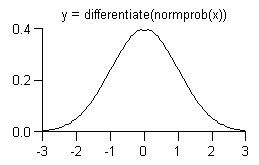 the probability that a normally distributed variable of mean 0.0 and
standard deviation 1.0 has a value less than or equal to x.
the probability that a normally distributed variable of mean 0.0 and
standard deviation 1.0 has a value less than or equal to x.
|
| Code sample: |
x = (-60:60)/20;
y = normprob(x);
create Viewport page_1.viewport_1;
create Domain page_1.viewport_1.domain_1;
create Graph page_1.viewport_1.domain_1.graph_1
( XuNgraphType = "line",
XuNxData = "x",
XuNyData = "differentiate(y)*20"
);
|
| See also: |
normrnd - normally distributed random numbers
| Syntax: | float normrnd(float n) |
| Description: | Return n numbers normally
distributed with mean 0 and standard deviation 1.
|
| See also: |
| Syntax: | float not(float
x) not x |
||
| Description: | Return the logical
inverse of each element of x. If an element is true
return false (0), if it is false return true
(1).
|
||
| Example: | x | not(x) | not x |
| 0 1 2 |
1 0 0 |
||
| Code sample: |
if not exists(page_1.view) create Viewport page_1.view; |
||
| See also:: | |||